
- Hyperliquid continues to attract institutional capital, including from companies in traditional sectors of the economy.
- This is achieved through diversified market products.
The Decentralized Finance Landscape (DeFiThe cryptocurrency market is undergoing a major transformation, and Hyperliquid is at the forefront of this movement. Created as a decentralized perpetual futures exchange, the platform is transforming into a comprehensive global financial ecosystem, attracting the attention of both major traditional and digital financial institutions.
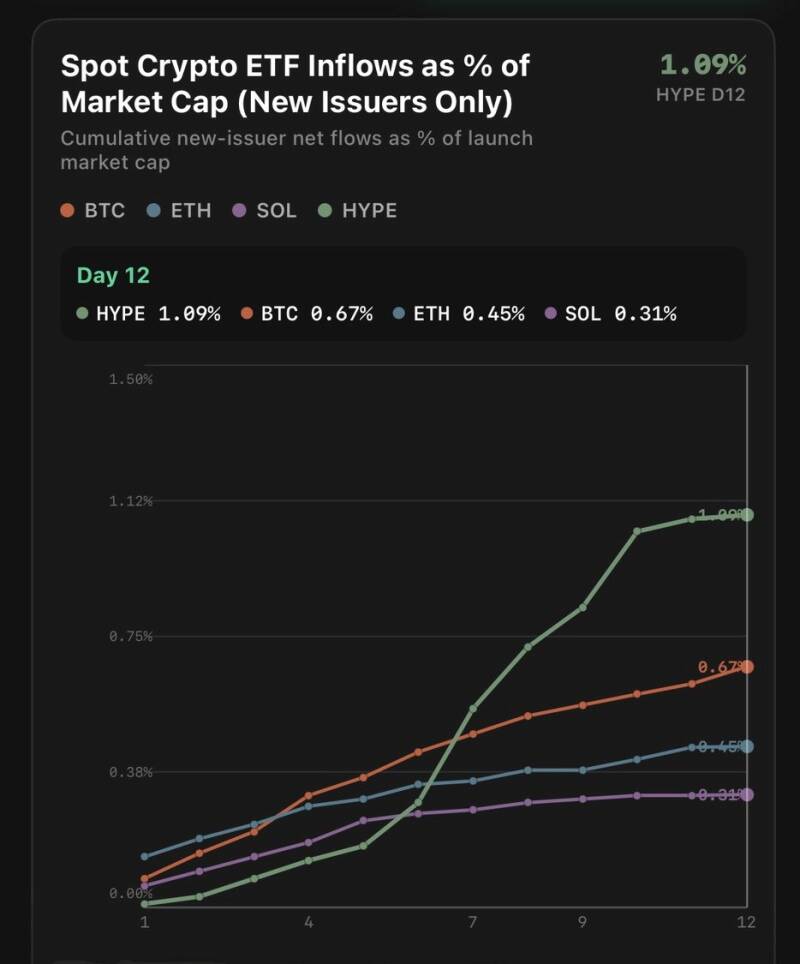
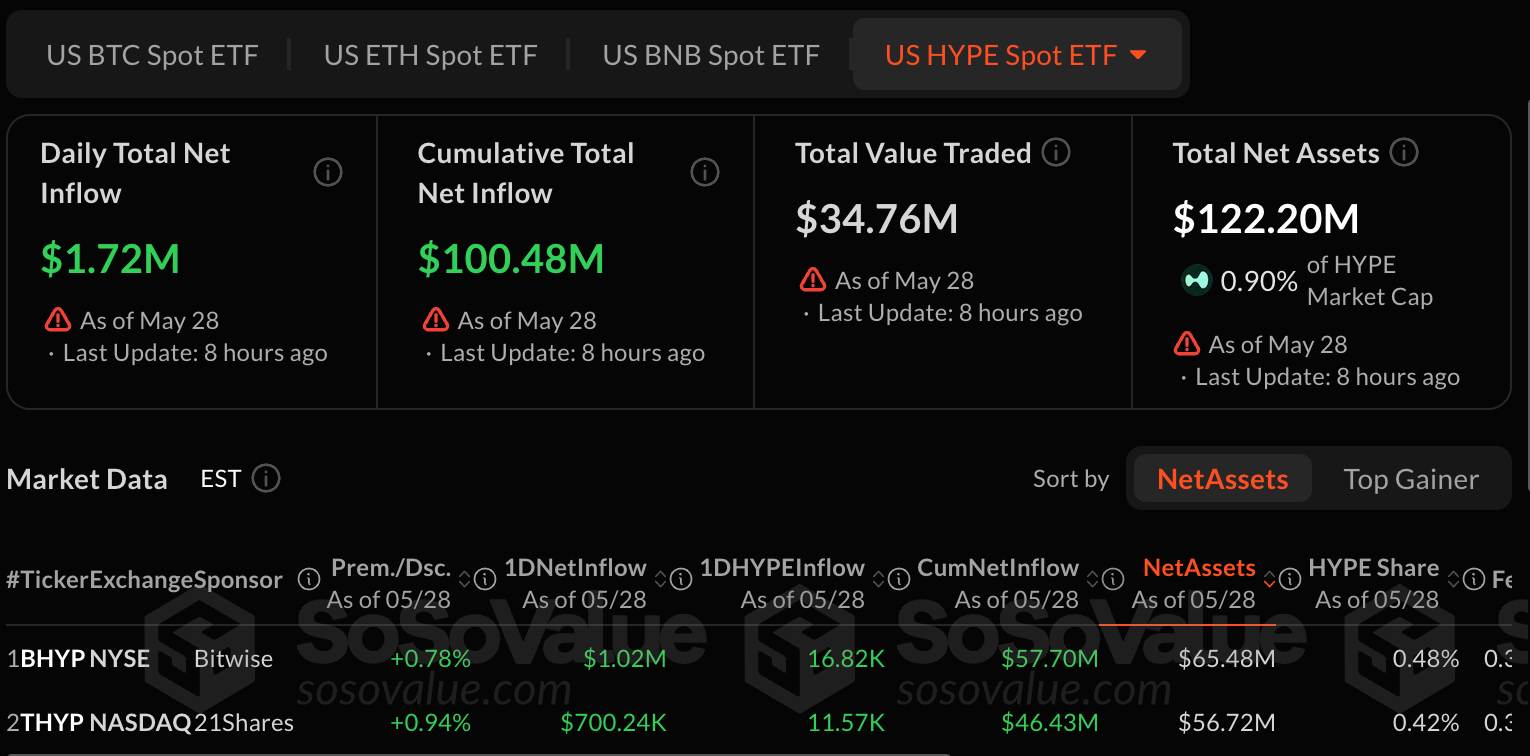
The main factor shaping the current institutional discourse is the outstanding market efficiency Hyperliquid HYPE’s own asset. The cryptocurrency market has faced significant challenges in recent months, characterized by sluggish Bitcoin price movements and a noticeable slowdown in spot market inflows. ETFDespite this, HYPE grew in value, and investments in the platform exceeded $100 million.
Source: @alex_hunter20
According to the latest According to According to the SoSoValue market monitoring platform, net daily inflows have recently shown signs of slowing. Maintaining long-term momentum is inextricably linked to the speed of subsequent institutional adoption, especially for fundamental assets such as Bitcoin, remain under pressure.
Source: SoSoValue
Going beyond derivatives
The main catalyst for institutional investors to view Hyperliquid as an efficient financial machine rather than a niche, decentralized application is the introduction of diversified market products, including:
- Highly liquid prediction markets;
- Synthetic stock investments designed to track pre-IPO assets;
- A seamless, 24/7 infrastructure for cross-border trading of global commodities and traditional stock indices;
- Seamless, EVM-compatible development platform via HyperEVM.
Jeffrey Sprecher, CEO of Intercontinental Exchange (ICE), the parent organization of the New York Stock Exchange, noted that Hyperliquid’s fundamental structural innovation could evolve into something much bigger than the NASDAQ.
Hyperliquid’s dedicated team has helped the protocol generate nearly $800 million in annual revenue, demonstrating enterprise optimization metrics that dwarf those of established global fintech competitors.
A mechanism to ensure parity with centralized exchanges
To understand how Hyperliquid was able to process a staggering $2,9 trillion in perpetual futures volume and manage nearly $7 billion in open interest in a single cycle, it’s important to understand the platform’s blockchain architecture. Most competing decentralized protocols are built on top of other networks, which inevitably leads to latency, high fees, and vulnerability to bugs. Hyperliquid’s developers created their own Block, designed exclusively for processing financial markets.
This institutional-level infrastructure operates on the basis of three specialized structural systems:
- HyperCore: A highly optimized, custom-designed L1 engine designed to handle large order volumes, real-time margin calculations and instant liquidation;
- HyperEVM: high performance, compatible with Ethereum a smart contract environment that allows third-party developers to create native applications that use the aggregated liquidity pool platforms;
- HyperBFT: A custom-designed, ultra-fast, delegated Proof-of-Stake consensus mechanism that provides deterministic security and efficient network validation.
This localized technology stack enables the platform to maintain a fully visible order book and sub-second transaction routing. Traded assets remain completely non-custodial and cryptographically verifiable on the blockchain, eliminating the counterparty default inherent in opaque centralized organizations.
However, there are also bottlenecks: the network currently operates with a relatively concentrated structure of validators and uses a closed-source software model, which creates technical centralization.
Risk Warning:
The information on this website is for informational and educational purposes only and does not constitute investment advice or financial recommendations. Cryptocurrencies and digital assets carry a high level of risk, including possible loss of capital. The editors are not responsible for decisions made based on the published materials. It is recommended that you conduct your own research (DYOR) before making investment decisions. Read the editorial policy. https://happycoin.club/about/