
- Messages about successful selection 15-bit key for elliptic curve with the help of a quantum computer were found to be incorrect.
- The classical brute force method gives exactly the same result.
Statement of alleged quantum breakthrough, directed against Bitcoin’s cryptography, immediately drew skepticism. Analysts argue that the results do not demonstrate any measurable quantum advantage.
This is complete nonsense; the quantum component can be replaced with a random number generator and get exactly the same results, on-chain analyst Checkmate refuted this claim.
Independent developer Yuval Adam reproduced The described method, substituting random values for quantum data, also succeeded in recovering identical keys. This experiment suggests that the obtained result is based on classical brute-force methods, and not on any quantum computing.
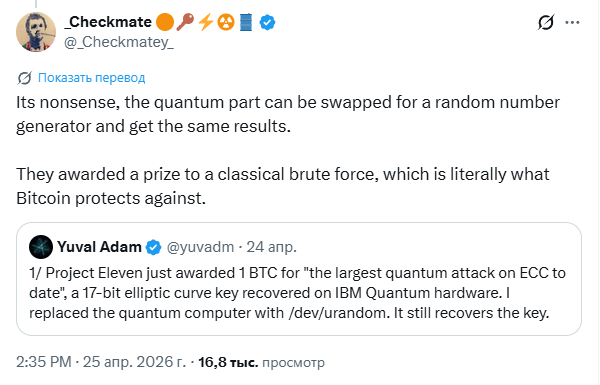
Yuval Adam tested this method after Project Eleven awarded 1 BTC to Giancarlo Lelli for recovering a 15-bit elliptic curve key using IBM quantum systems. Adam replaced the quantum system’s output with random bytes from /dev/urandom and ran the same process.
I did fork The winning repository removed the calls to IBM’s quantum systems and replaced them with random bytes. Each recovered key matches the one reported by the author, the developer wrote.
This result suggests that the system does not rely on quantum computing.
Adam’s analysis points to the probabilistic, rather than quantum, nature of the process. The pipeline accepts random variants that pass the verification stage, meaning that multiple attempts allow the key to be recovered.
With enough random attempts, success is inevitable, the expert pointed out.
The experiment used short keys that are incompatible with Bitcoin’s 256-bit standard, significantly limiting the practical significance of this study. A 15-bit key has only 32,767 possible combinations, which even the simplest computers can brute-force in a matter of minutes. This poses no real threat to Bitcoin’s cryptographic security.
Nevertheless, the race for quantum technologies continues to gain momentum. Various companies, including Google, plan to transition to post-quantum cryptography by 2029. And Bitcoin-developers are already preparing for such a scenario.
Risk Warning:
The information on this website is for informational and educational purposes only and does not constitute investment advice or financial recommendations. Cryptocurrencies and digital assets carry a high level of risk, including possible loss of capital. The editors are not responsible for decisions made based on the published materials. It is recommended that you conduct your own research (DYOR) before making investment decisions. Read the editorial policy. https://happycoin.club/about/