In today’s tweet Renowned economist and equally renowned Bitcoin critic Peter Schiff shared moving reflections on the enduring influence of his father, Irving Schiff. It turns out his family history is tied to radical challenges to the American financial and legal systems.
Irwin Schiff (1928–2015) was one of the most vocal opponents of the United States tax system. His entire life was devoted to arguing that the federal income tax is not only unconstitutional but also levied through legal fraud.
Philosophy of resistance
Irwin Schiff’s theories were described in his controversial a book “The Federal Mafia: How the Government Illegally Imposes and Illegally Collects Income Taxes.” His arguments relied on several key points that continue to generate controversy in libertarian and alt-right circles. financial theory.
“Voluntary” nature of taxationSchiff argued that because the IRS uses the term “voluntary compliance,” filing a tax return is technically optional and cannot be legally required.
Definition of “income”He argued that the term “income” as used in the law refers exclusively to corporate profits. According to his interpretation, the exchange of personal labor for wages is not a taxable event.
The gold standard and “legal money”Schiff believed that since Federal Reserve notes were no longer backed by gold or silver, they did not qualify as “legal money.” Therefore, he argued, the receipt of these notes could not be taxed as income.
Constitutional restrictionsHe argued that the 16th Amendment did not give the government the power to tax individual wages directly without apportionment among the states.
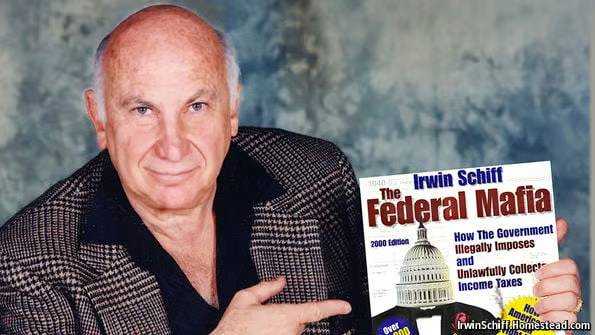
Irwin Schiff with his book “The Federal Mafia”
A high price for principles
Although Schiff’s arguments found staunch supporters, they met with fierce resistance from the federal judiciary. Every court that heard his cases dismissed his theories as “frivolous” and “baseless.”
The legal consequences for Irwin Schiff were severe. He faced multiple criminal charges for tax evasion and fraud. In 2005, he was sentenced to more than 13 years in prison. In 2003, a federal court, a rare occurrence in the United States, even issued an injunction preventing the sale. books “Federal Mafia”, calling it “fraudulent sales speech.”
Schiff died in 2015, at age 87, while in federal custody.
Schiff’s Legacy in the Modern Era
Today, Peter Schiff continues to build on his father’s skepticism about government-managed currencies. Although Peter has publicly stated that he considers some of his father’s legal methods impractical and doomed to failure, he acknowledges the intellectual merit of his father’s arguments against the current monetary system.
For the cryptocurrency community, Irving Schiff’s story became a harbinger of modern debates about decentralization and financial autonomy. Schiff Sr.’s fight was waged in the courts and, through tax denial, the digital asset movement seeks to create systems that operate outside the traditional “federal mafia” structure using code and cryptography.
Irwin Schiff’s arguments that the income tax is illegal are shattered in 2026 by the agreement between the SEC and the CFTC. The 16th Amendment gives Congress the power to tax “income from whatever source sourced.” After the signing of the historic memorandum between the SEC and the CFTC in March 2026, asset classification became more transparent. For the IRS kriptovalyuta remains property.
If Irwin Schiff argued that dollars are not money (because there is no gold backing), today the US Internal Revenue Service agrees that “Bitcoin “It’s not money in the classic sense, it’s property, so you pay capital gains tax every time you buy coffee.”
Given that Tax Day remains a central date in the American psyche, the memory of Irwin Schiff serves as a reminder of the tragic history of those who challenged the power of the state over personal wealth, and the high price they paid for it.
Risk Warning:
The information on this website is for informational and educational purposes only and does not constitute investment advice or financial recommendations. Cryptocurrencies and digital assets carry a high level of risk, including possible loss of capital. The editors are not responsible for decisions made based on the published materials. It is recommended that you conduct your own research (DYOR) before making investment decisions. Read the editorial policy. https://happycoin.club/about/