
- Analysts at Outset Media Index studied the relationship between Bitcoin prices and media coverage.
- The conclusion is that market movement begins before the news becomes a trigger for trading decisions.
The news often looks for reasons behind cryptocurrency price fluctuations. Bitcoin’s price movements are often attributed to external events: macroeconomic factors, the pandemic, exchange crashes, or regulatory delays. The recent geopolitical upheavals in Iran are another clear example.
With each new emotional surge, the market tries to predict whether it will Bitcoin A risky asset or a safe haven. Or perhaps it will fall victim to panic selling. But no matter how convincing the headlines, news rarely influences the movement of the leading cryptocurrency these days.
This is confirmed by the latest report The Outset Data Pulse (ODP) from the analytics platform Outset Media Index. The study’s authors examined 4381 days of historical Bitcoin closing price data and nearly 64 headlines from CoinDesk, one of the most consistent and authoritative media outlets in the crypto industry.
The results showed that on the daily timeframe, there is no statistically significant correlation between Bitcoin’s price and the volume of news publications, and the tone of these publications hardly explains subsequent price movements. This means that market movement begins before the news becomes a trigger for trading decisions.
Loud headlines don’t send clear signals
The discrepancy found is particularly noticeable in the case of the most significant news, the effect of which is difficult to interpret in two ways:
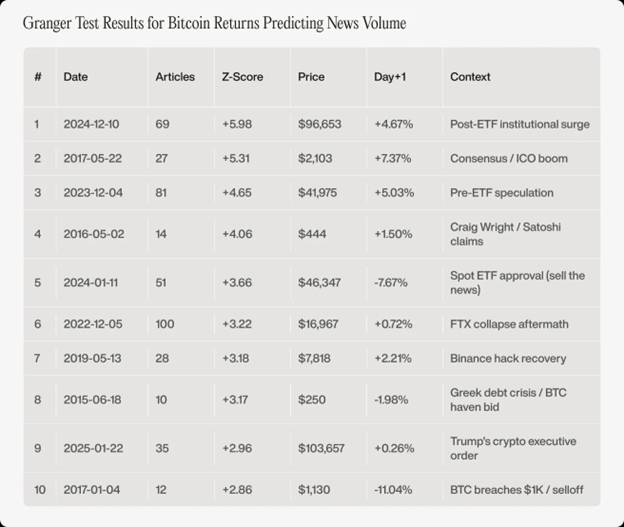
- Spot approval ETF + Bitcoin (January 11, 2024): On this day, CoinDesk published 51 articles. Bitcoin’s price immediately fell by 7,6%, and over the next three days, it plummeted by 10%.
- Aftermath FTX collapse (December 5, 2022 – the busiest day of the entire study period): CoinDesk published 100 materials, however Bitcoin practically did not react to the news, adding only 0,7% to its price.
- Bitcoin reached $1000 for the first time (January 4, 2017): the event made headlines, but the next day the coin lost 11% in value, and three days later – another 20%.
Source: Outset Data Pulse
Because the price usually changes in tandem with news releases, it appears as if there’s a clear cause-and-effect relationship between the two events. However, in reality, the market is basing the news on Bitcoin’s price even before it appears in the mainstream media.
What looks like a signal often turns out to be a lie.
A more in-depth analysis proves that crypto news, which the market has become accustomed to perceiving as signals, does not set a predictable vector for Bitcoin’s future movement. The report’s authors examined this relationship using:
- Granger causality tests;
- event analysis during days of surges in news activity;
- sentiment analysis of headlines using the FinBERT model;
- data clustering.
Granger causality tests were conducted on five short time periods. The results suggest that headlines cannot predict Bitcoin’s price movement. Interestingly, the inverse relationship, where price influences news releases, appears slightly more likely.
Another pattern is clearly visible on days of peak news activity: Bitcoin The price rises until a news story is widely covered, and then recedes. Thus, the release of a large amount of news is the result of the market “comprehending” the price movement, not a signal for its beginning.
The tone of the materials is also not a reliable factor in determining the trajectory of Bitcoin.
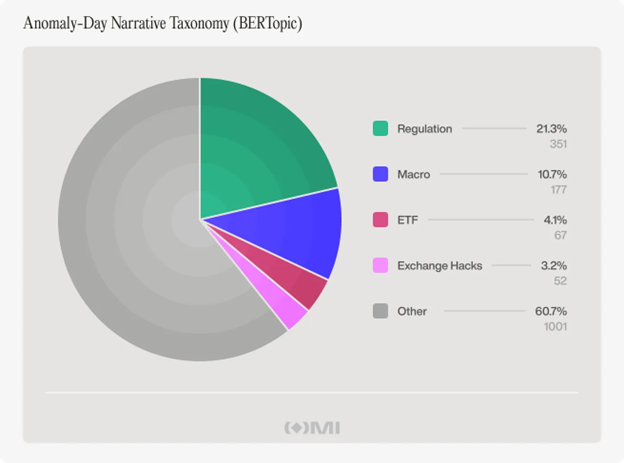
Even news related to cryptocurrency regulation (21% of all materials published during peak days) is not decisive. Moreover, analysts classify approximately 61% of materials as “background industry noise.” This includes news items such as partnerships, funding rounds, product launches, and events in the stablecoin world. NFT и Block-games
Source: Outset Data Pulse
It is significant that halving, one of the most significant factors driving Bitcoin’s long-term price growth, does not appear as a separate thematic cluster in the event analysis. This suggests that key events do not necessarily manifest themselves through daily headlines as is commonly believed.
What the study’s findings reveal about the real relationship between news and Bitcoin
ODP analysts argue that news is still important. It helps understand what factors the market has already priced into Bitcoin, organizes events, and provides meaningful context. But it doesn’t always give traders an advantage.
For those trying to analyze Bitcoin’s movements in real time, this makes a significant difference. A catchy headline can serve as a call to action because it brings clarity. But clarity emerges after the market has digested the uncertainty. The information the reader receives in the form of news has already been acted upon by Bitcoin.
Therefore, the release of materials confirming the signal gives traders both a sense of awareness and an understanding that it is too late to make a trade.
Does this mean that Bitcoin Doesn’t react to news at all? Of course not. Analysts point out that while high-profile news events can rock the market, the effect can be seen over a shorter period, such as a minute timeframe. If a news story causes a price spike, but it returns to its previous level within half an hour, a daily timeframe won’t show this movement. Furthermore, the tone of publications often changes; CoinDesk, while a representative media resource, still doesn’t provide the full picture; and social media or closed insider channels can transmit signals faster than traditional media.
However, the study offers a different perspective on common trading strategies: in the cryptocurrency market, hot headlines are often perceived as triggers for decision-making. But Bitcoin doesn’t wait for news to break before making a move. If a news story is making headlines, it means the market is already one step ahead.
Risk Warning:
The information on this website is for informational and educational purposes only and does not constitute investment advice or financial recommendations. Cryptocurrencies and digital assets carry a high level of risk, including possible loss of capital. The editors are not responsible for decisions made based on the published materials. It is recommended that you conduct your own research (DYOR) before making investment decisions. Read the editorial policy. https://happycoin.club/about/