Updated: 04.04.2026
Amid talk of the risks of quantum computing for the Bitcoin blockchain, Blockstream CEO Adam Beck advocated a gradual upgrade strategy. He believes that users should have time to migrate safely.
He also noted that Taproot’s architecture on the Bitcoin network already includes elements ready for quantum computing. This allows for smooth testing before mass deployment.
On the social network Back saidthat even leading quantum computing researchers may misunderstand Bitcoin’s structure. He cited the example Article Google, which misinterpreted Taproot and Schnorr, which it said were “specifically designed in 2018/19 as a barrier to quantum attacks using Tapleaf’s PQ-connection schemes.”
He added that Tapleaf’s commitment scheme was subsequently officially proven secure against quantum attacks, demonstrating Bitcoin’s built-in resilience.
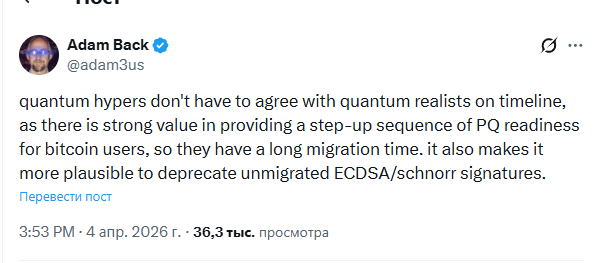
At the same time, Beck warned against the hasty implementation of new cryptographic technologies:
Rushing cryptography development is extremely dangerous, as most NIST PQ candidates have been broken or rejected.
For this reason, Bitcoin developers are starting with simple cases, initially securing cold storage. They will then gradually move on to complex wallets and smart contracts.
Post-quantum signatures are already being tested in second-layer networks. In particular, Blockstream Research introduced SHRINCS verification on the Liquid network, allowing users to secure funds with hash signatures without changing the consensus rules.
Back noted that Liquid frequently tested features before being implemented on the Bitcoin mainnet, including Schnorr, CSV, and followedThe use of SHRINCS provides systems like Bitcoin with quantum security today, leaving the development of complex smart contracts for future updates.
Risk Warning:
The information on this website is for informational and educational purposes only and does not constitute investment advice or financial recommendations. Cryptocurrencies and digital assets carry a high level of risk, including possible loss of capital. The editors are not responsible for decisions made based on the published materials. It is recommended that you conduct your own research (DYOR) before making any investment decisions.